Lange Nacht der Wissenschaften - TU Berlin - 22.06.2024
pierre, on behalf of the dial radio team
here to talk about diy webradio, some of its influences and implications
ramble map:
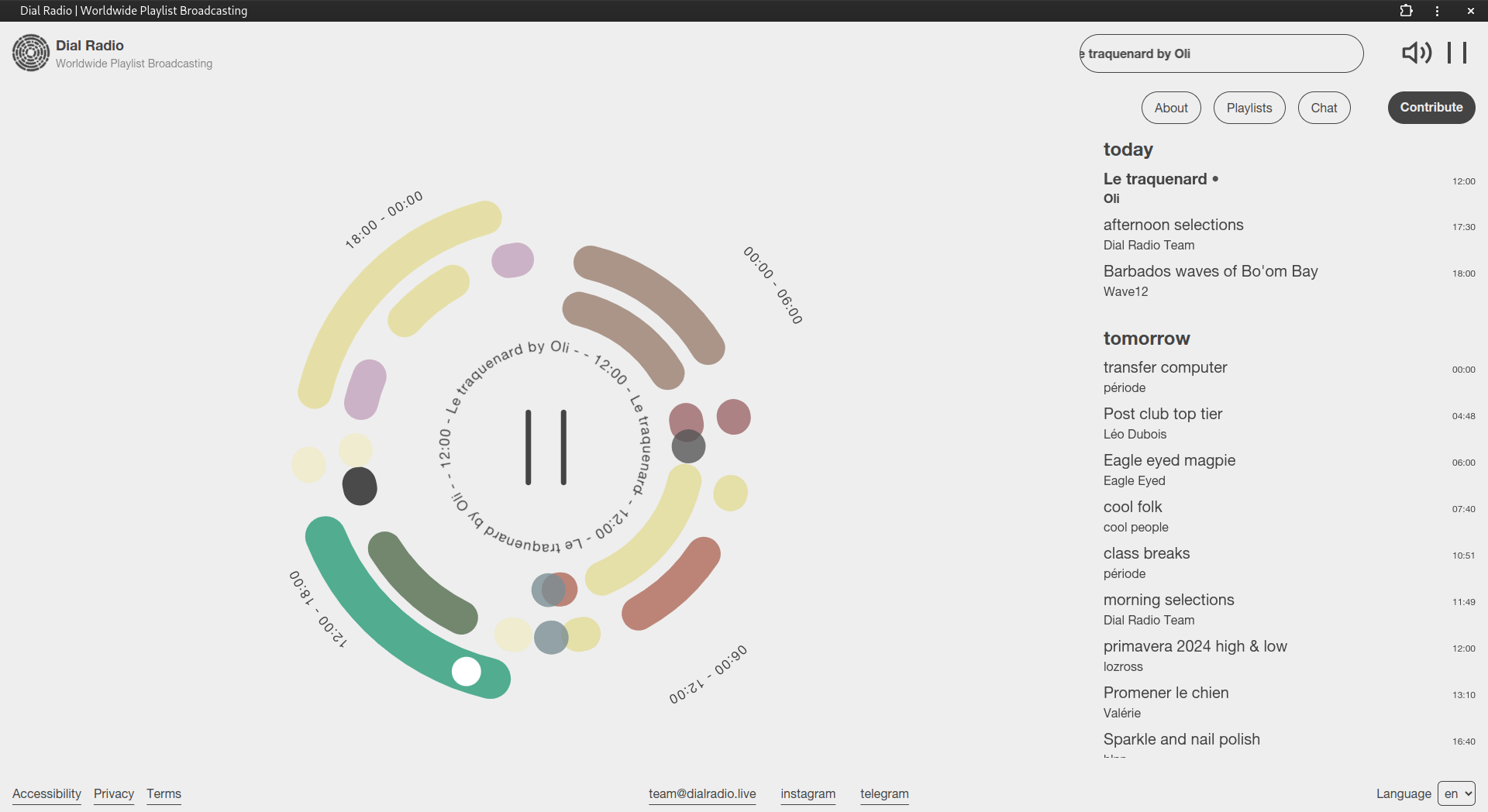
dial radio is a worldwide playlist broadcasting station.
anyone contributes playlists, and we play them.
every day is divided in four moments:
a playlist is essentially a URL, and a moment
each contributed playlist is played within the 72 hours
volunteers (design, communication, events, development, vibes)
170 playlists as of today + concerts and workshops
(the tech part is also interesting)
radio as a synchronous medium.
Radio has very interesting spatio-temporal properties. It's broadcast from somewhere, at a particular time. You don't have access to a broadcast if you're not in the right place, at the right time.
And because radio is synchronous, it easily adapts to the natural cycle of things, the most basic being day and night. In this sense, radio shares the same quality as the weather: it's the one thing we all share. All live broadcasting is always defined in relation to this cycle: it's always morning somewhere, it's always evening somewhere.
Moving radio to the web involved some changes to this configuration. The spatial component doesn't matter anymore: wherever you are in the world, as long as you have internet access, you can listen to the radio.The temporal component is also negated: the synchronous broadcast shifts to asynchronous playback; meaning that the radio becomes more user-centered (the technical system adapts to the user), and less program-centered (the user adapts to the technical system).
Podcasts, as an _asynchronous medium_, are the epitome of such change. To me, they emobdy the difference between __playing__ a show and __tuning__ to a show. On the one hand, you extract a singular piece of broadcast from a collective group, and on the other hand, you insert yourself into the listening stream.
the intent was to recall this continuous being-together, in the wake of digital de-synchronization.
(cf. the will-to-synchronize in infinite distraction, by dominic pettman, and hannah arendt’s res publica in the human condition)
Synchronicity also implies a sense of sharing: two entities need to share the same temporal referent in order to be synchronous. Synchronicity is commonality. Synchronicity is also analog, continuous.
On the opposite, the digital alwaus involves a process of breaking down, in order to operate at a super-human speed. As a result, software technicians need to go to great lengths to re-create the illusion of _real-time_.
This also has social consequences, one in which we're no longer watching the same thing, or hearing the same thing. All the things we're watching or listening have some shared basis (the platform we all use), but diverges for individual preferences (the specific series we watch).
While mass-broadcasting brought us the Tageschau and Tatort, it also brought us this shared space for attention, this public space, in the sense of Arendt. The morning broadcast of radio also has this role of shared existence. We can also see this at work when we look at revenue stream for artists: less from individual listens, and more from the shared experience of the concert.
Dial radio stands on the synchronous side of things.
webradio as a lowering the barrier to entry.
There used to be a dream of mass media, considered as the broadest access to quality content for the most people. Perhaps the biggest one was that of film, as theater for the masses, as a means to both entertain and provoke, always in a collective way.
However, its limitation was that it was one-way, one-to-many. There was a low-barrier to output, to delivery, but there remained a high-barrier to input. This changed with the advent of the web. The barrier to entry lowered radically, and the means of production became easily seizable.
Radio must be transformed from a distribution apparatus into a communications apparatus. The radio could be the finest possible communications apparatus in public life, […] if it understood how to receive as well as to transmit, how to let the listener speak as well as hear, how to bring him into a network instead of isolating him.
brecht, in the 1920s
But just because something becomes accessible, it doesn't mean that people will access it. I always had mixed feelings about the exclusivity of radio communities: it's very cool to be part of it, but it also feels like it's somewhat exclusive. There are those that are DJs and those that are not DJs, those who speak and those who listen.
So there are economic mechanisms of having easy access to the means of broadcasting, but there are also the social mechanisms of people being able to broadcast.
the legitimacy of taste, and its power dynamics.
Taste can have a powerful discriminatory role: it implies that there is good taste, bad taste, taste better than others.
Some people feel like they have nothing to say, which is a difference between amplifying a voice, and finding a voice. It feels like that one way to understand community radio is by involving processes of inclusion and processes of exclusion, e.g. "you are part of a community radio", means that there are people who are not part of it. This is why we propose to replace it by ease of access, allowing for a seamless moving in and out of communities.
(music as a masculine domestic power)
if you like a song, it’s worth being listened to..
broadening the domain of what is considered legitimate (aka anarchist curation).
The general artistic direction of the radio starts from the assumption that things are worth being listened to. So yes, doors can be open to anyone, but you also need to make sure that they feel welcoming, and that there are no steps at the entrance (otherwise, people on wheel chair can't make it).
All of this involves particular decisions beyond the theoretical and the technical: visual and interaction design long with outreach. This principle, I like to call it 'design for your mom': our moms are a competent human beings, but might also share little of the visual and interaction culture that we are used to, so we also need to make the interface of the website as accessible and usable as possible. The remote inspiration here is the government website of the United Kingdom. Top-rate designers made something that _anyone_ could use, and that actually involves a lot of work, trial and error, and clarity on what exactly you want to achieve: decent access for all, rather than great access to a few.
practices shape tools shape practices shape tools shape practices shape tools shape practices shape tools shape practices shape tools shape practices shape tools shape practices shape tools shape practices shape tools shape practices shape tools shape practices shape tools shape practices shape tools shape practices shape tools shape practices shape tools shape practices shape tools shape practices shape tools shape practices shape tools shape practices shape tools shape practices shape tools shape practices shape tools shape practices shape tools shape practices shape tools shape practices shape tools shape practices shape tools shape practices shape tools shape practices shape tools shape practices shape tools shape practices shape tools shape practices shape tools shape practices shape tools shape practices shape tools shape us.
cf. ursula le guin’s carrier bag theory of fiction.
Another part of this project is the relationship between the technical system we build and the affordances it provides us. In general, I believe that any act of creation is hardly separable from the technology used to do so (one limit to this argument might be using one's own body, but I would argue that, at this point, you are treating as some sort of machine).
I recently read the carrier bag theory of fiction, and it provided a very nice perspective on the relationship between technology and narrative. She makes the distinction between the technology of the spear, entangled with the story of the hero, and the technology of the bag, entangled with the story of the everyperson.
So if you're technical setup is a single DJ booth where no one else is allowed, you are veering towards a hero narrative; if the setup is an apersonal welcome package, you're veering towards everyday aesthetics.
For us, the technical design was to try to mimick this bag approach: whatever platform, whatever source, we try to make it as easy and painless and casual to contribute. We strive to be liberal in what we accept, and rigorous in what we share.
radio as small scale.
implemented through the anonymous user, and inspired by tetsuo kogawa’s mini-fm.
Another design decision is that of the scale of the setup. There's often an imperative of trying to make things scale, to reach more people, more places, have more content, etc.
An example of this small scale is the decision to not have any user accounts, and therefore operate on a semi-anonymous basis.
One of the first thing I was told, when I started doing radio, was "always remember that you're both talking to thousands of people, and to single individuals at the same time". The same way TV presenters invite themselves in our living rooms every day, radio has a very intimate aspect, intertwined within its mass broadcast possibilities. When we couple this with the ability for anyone to move from listener to broadcaster in a non-radical manner, this soft bridge between the private and the public is the anonymous.
There's also this growing place of the face of the artist in contemporary broadcasting, that I feel a bit uneasy about. It started by putting a spotlight on the DJ during parties, and developed into video-streamed DJ sets, where visual presence is as important as a sonic presence.
So part of the reasoning for not having user accounts, is to prevent too much individualization. Another nice consequence about this small scale decision is that certain class of problems disappear (e.g. hate speech)!
Brecht used to say that, even though you give the people the means of expressing themselves, they might not have something to say. But the nice thing about playlists is that the expression of the individual, the curation, has already taken place. The prototype of what is to be shared is already there. They have something to say. Whether they want to say it or not is up to them, while our responsibility is to make sure that all the conditions are there to best facilitate this expression.
Finally, another part about small-scale is replicability: the whole thing can easily be set up by someone else in another timezone. Rather than a _worldwide_ playlist broadcasting station, it could be interesting to thing of it as _federated_ playlist broadcasting stations?
the legal aspects are somewhat foggy.
the financial aspects (of the radio, of the artists).